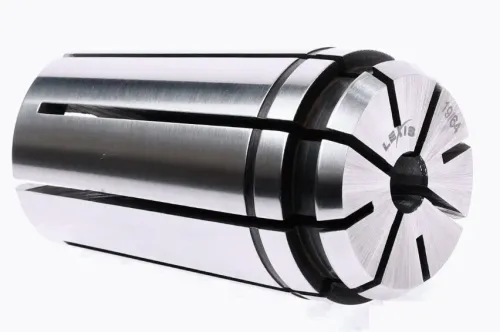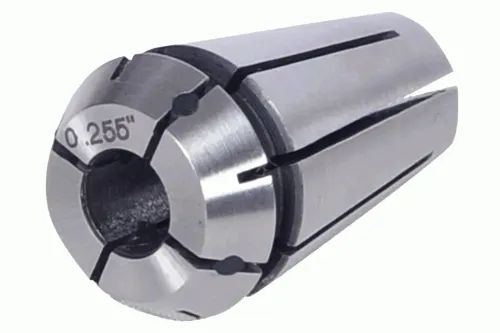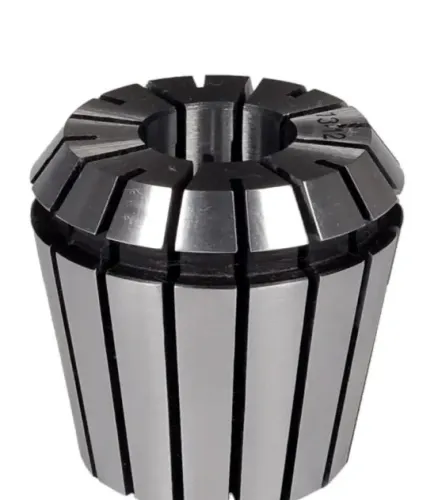


A sliding-head collet is a precision spring component, not simply a turned sleeve with slots. You will be able to follow each production stage, judge whether the collet matches your machine and bar stock, and ask a supplier for evidence that its claimed accuracy will hold after installation.
Key takeaways
- Check steel grade, blank diameter and surface defects before machining.
- Match the collet bore, nose geometry and closing range to your bar.
- Demand grip, runout and spring-recovery test records before purchase.
- Confirm the supplier can produce your machine’s exact collet specification.
From alloy-steel blank to slotted collet
A sliding head collet starts as certified alloy-steel bar, not as a finished tube. The steel is checked for grade, diameter and defects before being cut into blanks sized for machining allowance.
- Turn the blank’s outside diameter, nose and rear locating features; face both ends.
- Drill and rough-bore the central opening, leaving material for hardened-state grinding.
- Machine the taper, drawtube or closing-sleeve engagement, and other locating surfaces.
- Heat-treat the component to the drawing’s hardness target, commonly about 58–62 HRC for 100Cr6 or AISI 52100 spring steel. Verify hardness and record distortion after tempering.
- Mill or wire-cut the longitudinal slots, controlling their width, depth and spacing so every finger closes evenly.
- Grind the internal gripping bore, front nose and taper after heat treatment. These surfaces establish working runout; the outside diameter alone does not.
- Break sharp edges, deburr the slots, wash away abrasive residue and apply corrosion protection.
- Inspect the finished collet in its actual closing mechanism with a representative gauge or bar. Check bore size, taper seating, gripping length, spring recovery and mounted runout.
That last gate matters because a collet can look accurate in free state yet run poorly in a drawtube. The guide bush also affects bar stability and surface finish; an oversized or damaged bush can defeat good sliding head collet production.
A credible sliding head collet manufacturing India process therefore shows records for steel, heat treatment, slotting, grinding and final mounted testing.
Designing the collet for a sliding-headstock machine
The sliding-head collet is designed around moving bar stock, a nearby guide bush and the machine’s closing mechanism—not around its outside diameter alone. Its bore, nose, taper, finger length and drawtube engagement must work together in the actual spindle assembly.
1. Identify the Swiss-type machine make and model, spindle nose, collet profile and nominal bar range. A collet that fits the taper but misses the closing-tube position can clamp poorly or set the work at the wrong length.
2. Set the gripping bore for the bar profile and required clearance. The guide bush supports the bar near the tool; an oversized or damaged bush can cause chatter and runout that a precise collet cannot correct.
3. Choose the closing action. Draw-back collets pull the bar axially as the fingers close, while push-type or dead-length arrangements minimise axial movement. A sliding-head collet can therefore also be a dead-length collet; “sliding-head” identifies the machine application, not one universal standard.
4. Finish the gripping bore, front nose and locating surfaces after heat treatment. Equal finger action matters more than a visually accurate exterior, because uneven slots create variable grip and repeatability.
5. Treat the phrase sliding head collet manufacturing india as a sourcing description, not a specification. Request the machine drawing, bar profile, gripping length, action and permitted runout before comparing offers.
| Option | Design difference | Why it is not interchangeable |
|---|---|---|
| ER | Nut-driven, general-purpose spring collet | Its taper and nut envelope suit toolholding, not a sliding-head spindle |
| TG | Heavier toolholding collet with a different nut and taper system | Closing geometry does not match Swiss-type equipment |
| Step | Grips a larger stepped or irregular diameter | It is not intended for continuous bar feeding |
| Expanding | Clamps from inside a bore | It holds hollow work, not external bar stock |
| Standard lathe | Suits fixed-headstock workholding | It may lack Swiss-type closing and guide-bush geometry |
How manufacturers prove grip, accuracy and spring recovery
Reliable performance depends on measured geometry, not outside diameter alone. The critical dimensions are bore size and roundness, front-nose concentricity, locating-taper angle, gripping length, slot width, and the fit between collet, drawtube, spindle nose and guide bush.
A useful inspection file from sliding head collet production contains:
- Material certificate and heat-treatment lot number, linking each collet to its steel batch and furnace cycle.
- Hardness results against the drawing’s specified band, plus records showing quench, tempering and distortion control.
- Slot width, slot depth and finger symmetry measurements; unequal fingers produce uneven grip and premature spring loss.
- Bore, taper and nose measurements after grinding, taken with calibrated gauges or a coordinate measuring machine.
- Runout measured with the collet seated in the specified fixture, closed by the production mechanism, and gripping a stated bar diameter at a stated projection.
- Repeated closing-and-release results showing that the bore returns to size and the fingers recover without permanent set.
| Check | Evidence to request | Failure exposed |
|---|---|---|
| Runout | TIR or radial variation, bar size, projection and fixture recorded | A meaningless accuracy claim |
| Grip | Pull or torque test using representative round, hexagonal or profiled bar | Slipping, marking or uneven contact |
| Heat treatment | Hardness map, furnace chart and lot traceability | Soft fingers, cracking or distortion |
| Spring recovery | Before-and-after bore readings over repeated cycles | Permanent opening or loss of clamping force |
A sliding head collets supplier in Tamil Nadu should provide these records against the machine, collet type and acceptance limit you specify, rather than quoting “5 µm accuracy” without measurement conditions.
Matching the collet to the bar and installing it correctly
Choose the collet as part of a matched system: machine make and model, collet type, nominal bar range, gripping length, draw-back or dead-length action, material, and permitted runout. A nominal diameter alone is not enough; excessive collapse can spring the fingers and reduce gripping force.
- Round bar: match the bore to the actual measured diameter and variation, not just the catalogue size.
- Hexagonal bar: use a six-point internal form aligned with the machine’s indexing and bar orientation.
- Square bar: specify a four-sided form with corner clearance; a round bore will grip only the corners.
- Profiled bar: provide the exact cross-section drawing or sample, including flats, lobes, radii, and orientation.
- Special or thin-wall bar: confirm contact length and support without crushing the wall; ask for a dedicated profile rather than forcing a standard collet.
Clean the spindle nose, drawtube or closing sleeve, collet taper, and guide-bush bore before installation. Seat the collet fully, confirm the correct closing action, and set the guide bush close to the cutting zone.
The guide bush matters: damage, excess clearance, incorrect bore size, or diameter variation in the bar can ruin surface finish even when the collet is accurately ground.
Test with the actual closing mechanism and a representative bar or gauge. Check seating, smooth axial movement, gripping force, bar runout at the guide bush and cutting zone, and repeatability after opening and reclosing. A sliding head collet production record is useful only when its final test reflects these mounted conditions.
What to verify before buying from a Kinathukidavu supplier
Ask for a machine-specific production and inspection file, not a catalogue description. A sliding head collets manufacturer in Kinathukidavu should be able to connect each collet to your machine, bar profile and acceptance limit.
1. Send the machine make and model, spindle-nose detail, collet type, nominal bar range, gripping length, draw-back or dead-length action, and bar shape. Require a drawing that identifies the taper, bore, nose geometry and closing-tube engagement.
2. Request the material grade, heat-treatment certificate, hardness result and batch number. The supplier’s route should show steel preparation, turning, slitting, heat treatment, internal and taper grinding, deburring and cleaning—not merely “CNC machining.”
3. Demand a runout report measured after heat treatment and final grinding. It must state the bar diameter, projection or gauge length, inspection fixture or spindle, seating condition, and whether the result is total indicated runout or radial variation. “5 µm accuracy” without these details proves little.
4. Ask for records showing equal finger action, bore size, taper contact and spring recovery, plus a traceable final-inspection report. Missing batch identification or identical reports for every size is a warning sign.
5. Require a trial collet or acceptance sample tested with the specified guide bush, drawtube and bar stock. A sliding head collets supplier in Tamil Nadu that only offers a universal collet is not demonstrating sliding-head capability.
When comparing LEXIS TOOLING SYSTEMS PRIVATE LIMITED with another source, use this evidence checklist rather than location, product photographs or a broad “industrial collet” label.
Frequently asked questions
How does a manufacturer turn alloy-steel bar into a sliding head collet?
The process includes checking certified alloy-steel stock, cutting blanks, turning the body, machining the bore and nose, cutting slots, heat treating, finishing and inspecting the collet.
What design details matter for a sliding-headstock machine?
Check the machine interface, collet nose profile, bore size, closing range, slot arrangement, gripping length and clearance for the guide bushing and bar.
How do manufacturers prove a collet will grip accurately and recover its shape?
Ask for inspection results covering bore and outside diameter, concentricity or runout, gripping force, dimensional repeatability and spring recovery after repeated opening cycles.
How do you match and install a sliding head collet correctly?
Match the collet to the bar diameter, material, machine model and guide-bushing setup, then clean the taper and threads, seat the collet fully and set the closing stroke without over-compressing it.
What should you verify before buying from a Kinathukidavu supplier?
Verify the exact machine compatibility, steel grade, heat-treatment records, inspection data, traceability, sample approval process, replacement support and stated manufacturing tolerances.