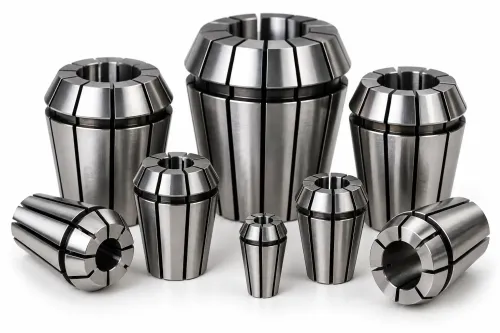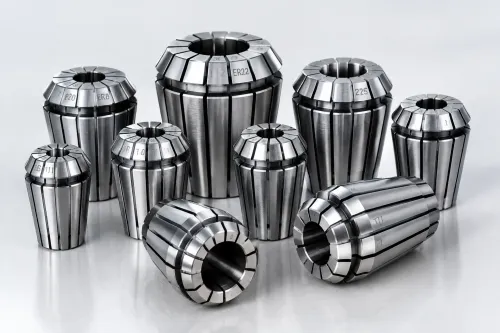


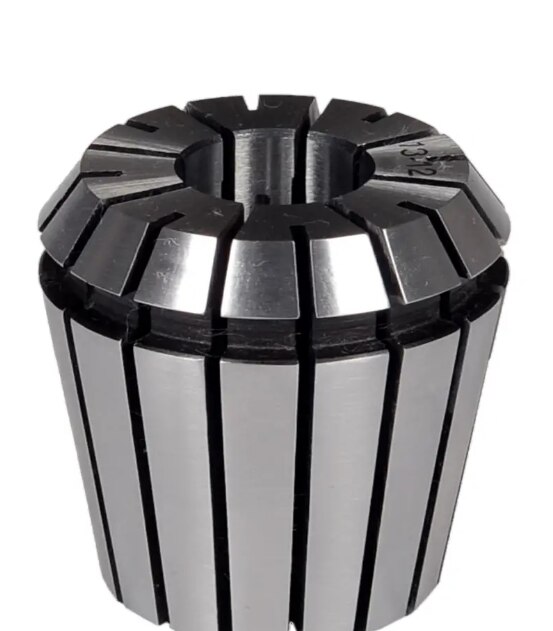
A replacement collet is not interchangeable merely because its label shows ER20, ER32, ER40, or a familiar bore diameter. You will be able to choose between radial ER clamping and dedicated crimping, verify the complete machine interface, and write a replacement specification that prevents runout, pull-out, and fit failures.
Key takeaways
- Choose ER for multiple shank diameters; choose crimping for one defined profile.
- Match the ER collet, holder, nut, and clamping range before ordering.
- Check bore, collapse range, runout, damage, and cleanliness on ER20 and ER32 collets.
- Treat ER40 replacement as a complete holder-and-nut inspection.
Choose the gripping method for the operation, not the label
Choose ER when you need one toolholding system to cover changing shank diameters; choose a crimping collet when the machine is designed to deform around one specified tool or workpiece profile.
In er collets vs crimping collets, the key difference is radial compression: an ER nut closes slotted fingers around the shank, while crimping applies controlled deformation through a dedicated holder and actuation method.
| Application | Choose ER when | Choose crimping when |
|---|---|---|
| Milling | Tool shanks change and quick replacement matters | One approved tool geometry needs maximum dedicated grip |
| Drilling | Drill diameters vary within the collet’s collapse range | A fixed drill and machine interface already use crimping |
| Turning | Live tooling uses an ER holder and standard shanks | A lathe spindle or tooling system specifies a crimp profile |
| Bar-feeding | Bars match the ER bore range and grip length | The feeder uses a shaped, deformable collet for one bar profile |
| Toolholding | You need interchangeable metric or inch shank coverage | The manufacturer specifies a matched tool-and-collet set |
| Workholding | Round workpieces fit the available bore and loads | The workpiece has a special profile requiring positive deformation |
For a replacement, compare the complete assembly rather than the label:
- Verify the existing holder taper, spindle interface, collet pocket, nut geometry, ER size, DIN 6499 form, bore system, precision grade, and axial stop.
- Keep the tool shank or workpiece inside the stated collapse range; forcing a smaller diameter causes uneven loading, runout, and weak grip.
- For crimping, demand the open and crimped bore, permissible tolerance, gripping length, force or actuation method, holder drawing, and load rating. A local supplier or an unbalanced holder does not prove interchangeability.
Match the complete ER assembly before ordering a replacement
An ER32 collet is not a universal replacement for every ER32 holder. The ER collets vs crimping collets distinction matters here: an ER collet compresses radially inside a matching nut, while a crimping collet grips a specified tool or workpiece profile. Verify the complete ER assembly before ordering.
1. Record the holder’s ER family and form, such as ER20, ER32, or ER40, and confirm the applicable DIN 6499 form. Match the outside taper, collet pocket, nut geometry, and spindle or machine interface.
2. Match the bore to the tool diameter and system units. Confirm metric or inch sizing, the stated clamping range, and the required precision grade; a similar nominal diameter does not prove interchangeability.
3. Check how coolant reaches the cutting edge. A standard slotted collet can leak through its slots, so match the replacement to the holder’s sealing nut, sealing disk, or sealed-collet design, plus the coolant pressure and delivery method.
4. Inspect the existing assembly before blaming the collet for runout. Clean the taper and nut threads, then reject any part with cracked or spread slots, a scored or fretted bore, face damage, corrosion, or poor return to its free condition.
5. Assemble correctly: snap the collet into the nut first, then thread the nut onto the holder. Ask for the assembled holder, nut, and collet’s permissible speed, balance grade, and runout; a precision collet cannot correct an unbalanced assembly.
Use bore, collapse range, and condition checks for ER20 and ER32
Select an ER20 or ER32 replacement by the marked bore and collapse range, then verify the complete assembly and collet condition—not the nominal series alone. ER20 covers approximately 1–13 mm and ER32 approximately 2–20 mm in typical metric ranges, but the manufacturer’s marking and drawing take precedence.
For an er 20 collets replacement or er 32 collets replacement, match the actual shank diameter to the stated range; do not force a standard collet to grip a substantially smaller tool.
- Confirm the bore is metric or inch and matches the tool shank, not merely the catalog family.
- Match the holder’s ER series, DIN 6499 form, outside taper, pocket geometry, and nut type.
- Specify the required runout limit, precision grade, gripping length, coolant passage, and balancing requirement.
- Compare the drawing with the existing nut and holder; similar tool diameters do not prove interchangeability.
- Reject a collet with a cracked or spread slot, scored or fretted bore, damaged face, corrosion, or inconsistent return to its free condition.
Clean the taper, bore, nut threads, and contact faces before judging fit or runout. Chips and dried coolant can make a sound collet appear oversized or inaccurate.
If the replacement still produces uneven slot loading, weak grip, or excessive runout after correct assembly, stop using the nominal ER label as the diagnosis and recheck the bore, collapse range, nut, and holder interface.
Treat ER40 replacement as a holder-and-nut inspection
An ER40 replacement is a holder-and-nut inspection, not a bore-size swap. Treat any “er 40 collet replacement” as compatible only after confirming the holder’s ER40 series, DIN 6499 form, outside taper, nut geometry, clamping range, and required metric or inch bore.
Check the complete assembly against the job:
- Measure the actual tool shank and select a collet whose collapse range covers it without exceeding the specified reduction.
- Record the holder interface, required runout limit, measurement gauge length, and precision grade. Runout comes from the spindle, holder taper, nut, collet, tool shank, cleanliness, and test setup—not the collet alone.
- Match the nut type. A standard slotted collet can leak coolant through its slots; coolant-through use requires a compatible sealing nut, sealing disk, or sealed-collet design rated for the holder’s pressure and delivery method.
- For high-speed work, obtain the assembled holder, nut, and collet balance grade and permissible rpm. Confirm the rating’s tool length and assembly assumptions.
- Assemble the collet into the nut before threading the nut onto the holder. Incorrect engagement can damage the eccentric retaining ring and create false clamping.
Replacing only the collet is unsafe when the nut has damaged threads, a worn retaining ring, burrs, or sealing damage; when the holder taper is marked or contaminated; or when measured runout exceeds the process limit. Stop the replacement if the new collet does not match the holder’s taper, nut, coolant system, or speed rating.
Write a crimping-collet enquiry that proves interchangeability
Do not accept “crimping collet” as a complete specification. The term does not identify one universal profile, so your replacement enquiry must describe the existing assembly and the geometry it grips. A search for a crimping collets supplier in tamil nadu is only a sourcing filter; local stock does not prove interchangeability.
Ask the supplier to confirm each point in writing:
- Exact collet profile, holder interface, open bore, crimped bore, and permissible shank or workpiece tolerance
- Crimping force, actuation method, axial stop arrangement, gripping length, and replacement procedure
- Material, hardness, dimensional drawing, inspection report, and measured repeatability
- Maximum runout at a stated gauge length, coolant requirement, and replacement lead time
- Assembled-holder balance grade, permissible speed, tool or workpiece length assumption, and test method
Compare the sample against your holder pocket, spindle or machine interface, nut, tool diameter, workpiece profile, cutting or clamping load, and required runout. Test a known-good tool or workpiece through loading, clamping, removal, and repeat loading; measure runout and pull-out or slip under the intended load.
The ER collets vs crimping collets choice is wrong if the crimping profile cannot grip that geometry without distortion.
LEXIS TOOLING SYSTEMS PRIVATE LIMITED can be included in a supplier comparison only after it provides these documents and measured results, not because it is located near your operation.
Related services
ER Collets ER20 Collet system also known as RD20 Collet system are standardized and manufactured as per DIN 6499 standard guidelines and are truly... View service → |
ER Collets ER40 Collet system also known as RD40 Collet system are standardized and manufactured as per DIN 6499 standard guidelines and are truly... View service → |
Frequently asked questions
How do ER collets differ from crimping collets?
ER collets suit changing shank diameters within a defined collapse range. Crimping collets deform around one specified tool or workpiece profile.
What should you match when ordering an ER20 or ER32 replacement?
Match the collet series, nominal bore, collapse range, holder interface, nut thread, clamping length, and required accuracy.
What should you inspect before buying an ER40 collet replacement?
Inspect the holder taper, collet pocket, nut thread, bearing surfaces, collet condition, and the complete assembly for damage or mismatch.
What information should a crimping-collet enquiry include?
Provide the machine and holder details, profile drawing, dimensions and tolerances, material, gripping length, tool or workpiece type, and interchangeability reference.
Related service
ER Collets ER32 Collet system also known as RD32 Collet system are standardized and manufactured as per DIN 6499 standard guidelines and are truly... View service → |