

Choosing an ER wrench by collet number alone can produce a poor fit because ER nuts use different flats, slots, diameters, and access clearances. By the end, you will know how to identify the nut, specify the wrench, assemble the collet safely, and check a supplier’s drawing before purchase.
Key takeaways
- Match the wrench to the ER nut drawing, not the collet number.
- Confirm nut diameter, wrench flats, thread, slot geometry, and height.
- Clip the collet into the nut before fitting it into the holder.
- Check full wrench engagement and use the nut maker’s torque value.
Why the ER collet number does not identify the wrench
The ER number identifies the collet size, not the wrench. An ER32 collet can be used with different ER32 nut designs, and those nuts can have different outside diameters, wrench flats, slot geometry, threads, and heights. Select an ER wrench for ER collets from the actual nut drawing, especially for compact spindle tooling.
- Identify the governing collet system: DIN 6499 or ISO 15488, the ER size, and the nut’s exact part number.
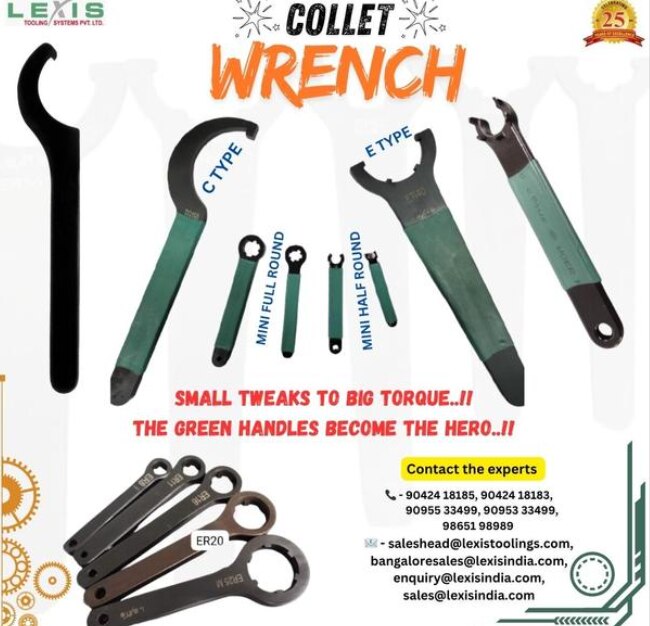
- Confirm the nut design. A slotted nut may require a hook or pin wrench; a hexagonal nut requires a flat spanner; another design may use a combined wrench with a specific face or pin arrangement.
- Check the nut thread, outside diameter, overall height, wrench flats or slots, and the clearance around the holder nose. These are the critical er collet wrench dimensions, not just the ER8, ER16, ER25, ER32, ER40, or ER50 label.
- State the required runout and confirm that the wrench engages the specified nut without contacting the holder, collet, or spindle.
Do not order a tool described only as “ER wrench.” Ask for a dimensioned wrench drawing and compatible nut numbers. Clean the nut slots, collet seating faces, taper, and bore before checking fit; chips or dried coolant can prevent full seating, create false runout, and make wrench engagement appear correct when clamping is not.
How ER nut size, wrench type, and dimensions fit together
Match the wrench to the nut’s outside engagement feature, not to the collet’s nominal capacity. A slotted standard nut takes a hook or face-spanner wrench; a nut with drilled face holes takes a pin-spanner wrench; an external hex nut takes a correctly sized open-end or socket wrench.
| ER size | Typical thread reference | Wrench style and dimensional check |
|---|---|---|
| ER8 | Confirm from the nut drawing | Hook, pin, or hex style as supplied; check compact outside diameter and slot or hole geometry |
| ER11 | M14 × 0.75 | Slotted hook or face-spanner; match the nut’s engagement width and clearance |
| ER16 | M22 × 1.5 | Slotted hook or face-spanner; verify jaw thickness against the slot |
| ER20 | M25 × 1.5 | Slotted hook or face-spanner; check outside diameter and spindle clearance |
| ER25 | M32 × 1.5 | Hook or face-spanner; confirm slot depth and wrench seating |
| ER32 | M40 × 1.5 | Hook or face-spanner; verify working diameter and handle clearance |
| ER40 | M50 × 1.5 | Hook or face-spanner; confirm engagement width before applying torque |
| ER50 | M64 × 2 | Hook or face-spanner; use the nut drawing to specify the larger working diameter and thickness |
Thread size confirms chuck compatibility; it does not select the wrench. Two ER32 nuts can share a thread yet use different slots, outside diameters, or bearing-assisted designs.
Specify overall length, jaw or pin diameter, thickness, handle width, and working clearance. Record the er collet wrench dimensions from the actual nut drawing, because a long handle can exceed the manufacturer’s torque table.
How to clip, load, and remove an ER collet correctly
Clean the holder taper, collet slots, bore, nut threads, and seating faces before assembly. A chip or dried coolant under the collet can create false runout, shorten gripping length, and make the torque reading misleading.
1. Place the clean ER collet inside the nut at a slight angle. Engage the collet’s groove with the nut’s eccentric retaining ring, then tilt or press it until it snaps into place. Do not push the collet straight into the nut; that can damage the ring or leave the collet unsecured.
2. Check that the collet is retained evenly around the ring and that its front face sits squarely in the nut.
3. Insert the cutting tool through the clipped collet and support it while starting the nut by hand on the holder. Leave clearance between the tool end and the bottom of the collet bore or holder. Do not force the tool against either surface.
4. Run the nut down by hand until the collet contacts the tool. Use the correct ER collet assembly tool only after the threads engage cleanly.
5. Tighten with the manufacturer’s torque table for that exact nut, lubrication, and collet size. The assembly tool does not control torque.
6. To remove the assembly, loosen the nut, withdraw the tool, and press or tilt the collet sideways at the retaining-ring opening until it releases. Never pry against the collet slots or precision seating faces.
How to control torque and verify wrench engagement
Use a calibrated torque wrench with the nut manufacturer’s torque table to control final tightening. An ER wrench for ER collets only works reliably when its working end matches the exact nut design and engages the flats, hook slots, or pins across the full contact area.
1. Clean the holder taper, collet slots and bore, nut threads, and seating faces. Remove chips and dried coolant; trapped debris reduces gripping length, creates false runout, and makes the torque reading misleading.
2. Fit the collet into the nut before placing the assembly in the holder. Confirm that the nut seats squarely and that the wrench engages without rocking, slipping, or contacting only one corner.
3. Check every hook tooth, pin, or flat for full contact. Reject a loose hook wrench, undersized open-ended wrench, or tool with burrs that mark the nut’s precision seating surfaces.
4. Tighten with the specified torque for that exact ER size and nut type. Do not copy one value across ER16, ER20, ER32, and ER40; lubrication, coating, sealed nuts, and bearing-assisted nuts change the required torque.
5. Keep the handle length under control. A long wrench can exceed the recommended torque even when hand force feels moderate, damaging the nut or overstressing the collet.
After tightening, release and retighten only if the manufacturer’s procedure permits it. Verify runout with a clean, known test bar; persistent runout after correct engagement points to contamination, a damaged seating face, or a mismatched nut rather than insufficient force.
What to request from an ER wrench supplier in Kinathukidavu
Request a dimensioned drawing, not a catalogue label. The drawing must identify the ER size, nut part number, thread, outside diameter, overall height, slot or flat geometry, engagement width, wrench thickness, handle width, overall length, and required working clearance.
Confirm whether the tool is a hook, pin, face-spanner, flat spanner, or combined wrench; two nuts for the same ER size can require different tools.
- State the governing system as DIN 6499 or ISO 15488, then name the exact nut model and compatible part numbers. “ER32 wrench” alone is incomplete.
- Specify the material grade, hardness range, and surface treatment. Ask whether the wrench is intended for hand tightening or use with a torque wrench.
- Record the overall length and engagement dimensions. An unnecessarily long handle can exceed the nut maker’s tightening torque and damage threads or distort clamping.
- Require inspection criteria: the wrench must seat without rocking, every hook tooth or flat must contact the nut, and no burr may interfere with engagement.
- Test the supplied tool on the exact production nut, checking that it leaves no marks on the nut’s precision seating surfaces.
For ER wrench specifications in Kinathukidavu, give the supplier your nut drawing or a measured sample and request a controlled drawing revision with material and inspection records.
LEXIS TOOLING SYSTEMS PRIVATE LIMITED can be included in a comparison only after you verify that its ER11, ER20, ER40, or ER50 collet range matches the nut and wrench interface you actually use.
Frequently asked questions
Does an ER32 collet require one specific wrench?
No. ER32 identifies the collet size, while ER32 nuts can differ in diameter, wrench flats, slots, threads, and height. Select the wrench from the actual nut design.
Which ER collet wrench dimensions should you verify?
Verify the nut’s outside diameter, wrench-flat or slot geometry, thread specification, nut height, and the wrench’s matching engagement profile.
How do you fit an ER collet into an ER nut?
Clip the collet into the nut first, then place the assembly into the holder and tighten the nut. Do not force a collet into a nut after tightening has started.
How can you check ER wrench engagement before tightening?
Seat the wrench fully on the nut flats or in its slots, confirm even contact, and stop if the wrench rocks, slips, or contacts only one edge.
What should you request from an ER wrench supplier in Kinathukidavu?
Request the matching ER nut drawing, wrench dimensions, engagement profile, material and finish details, torque guidance, and sample or inspection documents.